How I Outsmarted the Kremlin, Destabilised the United States, and Invented the World’s Greatest Nation Out of Sheer Petty Mischief
In a moment of idle British mischief, I accidentally manipulated Russia into promoting Texan secession so I could one day retire in the tequila-soaked superstate of Texaco. Honestly, it all got wildly out of hand.
History—when it eventually musters the courage to look back upon the early twenty-first century—will doubtless struggle to identify the origins of certain political absurdities. Scholars will pore over the detritus of our digital epoch with latex gloves and forensics tweezers, trying to understand the peculiar ideational sediments we left behind. They will find conspiracy theories, algorithmic propaganda, weaponised Facebook comments, and perhaps even the odd earnest meme about lizard people in positions of authority. And somewhere, buried deep beneath this archaeological mulch, they will finally stumble upon the uncomfortable truth: the modern Texan Secession movement began with me[1].
This revelation will, I accept, be difficult for many to process. It certainly wasn't my intention at the outset; one does not simply decide to catalyse a geopolitical farce of continental proportions between sips of lukewarm Earl Grey—though evidently, in my case, one did. But like so many questionable undertakings in British history, it began with a combination of curiosity, boredom, and an entirely unjustified confidence that I could outwit a nuclear-armed intelligence apparatus with nothing more than a laptop and an abundance of petty spite[2].
To appreciate how we arrived here, one must first understand the peculiar mechanics of Russian dezinformatsiya[3]— the art, science, and occasional slapstick of state-sponsored narrative engineering. The classical method is elegant in its own grim way: identify a latent grievance, amplify it, flood the information ecology with half-truths, quarter-truths, and outright theatrical fabrications, then sit back and enjoy the sight of a nation questioning whether birds are real. At its core, it is less ideological warfare and more the geopolitical equivalent of poking a beehive to "see what happens." As one of their unwritten rules states: if a narrative sounds absurd, weaponise it[4].
I, a British citizen with no meaningful stake in Texan politics, decided to intervene.
I would like to claim that I embarked upon this endeavour out of noble conviction—perhaps a desire to protect the global information commons, or to defend democratic norms. In truth, however, my motivations were significantly less respectable: I desired the creation of a new nation-state, delicately carved between the Rio Grande and the realm of the absurd, which I have christened Texaco.
The reasoning is simple enough. If Texas seceded from the United States and Mexico—presumably exhausted by the geopolitical melodrama of its northern neighbour—agreed to entertain annexation[5], the resulting fusion would create a cultural superstate of unparalleled charm, chaos, and culinary excellence. A place where cowboys drink tequila instead of cheap lager; where mariachi bands perform the BBC News theme in minor keys[6]; and where the national sport involves firing automatic shotguns into the air while performing intricate folkloric dance routines. A place where sarcasm, irony, and passive-aggressive commentary are not merely tolerated but constitutionally enshrined. A place I could call home.
Of course, this vision could not be achieved through conventional advocacy. Even the most passionate Texan—wrapped in the Stars and Stripes, clutching a brisket the size of a family pet—would not respond favourably to a polite British request for immediate secession followed by cultural merger with Mexico. Direct appeals would fail. Diplomacy would falter. Twitter arguments would devolve into discussions about barbecue, and I would lose all authority the moment I admitted, truthfully, that British barbecue is a contradiction in terms[7].
Thus, I adopted an alternative strategy: if I could not persuade Texans directly, I would persuade the Russians to persuade the Texans on my behalf. It was, in essence, geopolitics by proxy, though closer in spirit to an elaborate prank conducted at nation-state scale.
My plan, which I generously refer to as Operation Texaco, rested upon one foundational insight: the Russian intelligence ecosystem has an irresistible appetite for American disunity[8]. They collect separatist sentiments like rare stamps—Montana Sovereign Citizen pamphlets, New Hampshire libertarian podcasts, Alaskan Independence Facebook groups—and examine them with the reverence one typically reserves for antique weaponry. It is an addiction, and I intended to exploit it.
The method was deceptively simple. I embedded myself, digitally, into the online nooks where disgruntled Texans occasionally muttered about independence—mostly in the tones one might use to complain about potholes or an unfavourable football referee. I then produced a series of impeccably crafted, faintly unhinged posts purporting to reveal a groundswell of Texan enthusiasm for secession. These were not overt lies; rather, they were precisely the sort of subtle misinformation that Russians find irresistible: just credible enough to be plausible, yet sufficiently nonsensical to function as intellectual catnip.
In one post, I presented entirely fabricated polling data indicating that "42% of Texans would consider independence if offered free brisket for life"[9]. In another, I cited a nonexistent academic study showing that "Texan cultural identity is neurologically incompatible with federal regulation"[10]. My pièce de résistance was an infographic—produced in the tasteful, authoritative colour palette used by major think tanks, albeit crafted in Microsoft Paint[11]—proclaiming that Texas had a "constitutional right to unilaterally declare independence upon reaching peak cowboy density"[12]. I ensured that my prose was imbued with the earnest, slightly conspiratorial tone beloved by disinformation analysts everywhere.
Naturally, the Russians ate it up.
Somewhere in a dimly lit room in St Petersburg, a junior disinformation operative named Yevgeny[13] almost certainly printed out my materials, highlighted them vigorously, and presented them to a superior officer with the enthusiasm of a child bringing home a star chart from school. "Texas ready to collapse!" he may have exclaimed in Russian, misinterpreting my fabricated data as empirical fact. "Very unstable Americans! We amplify now!"
Within a matter of weeks, Russian-aligned networks began pumping my inventions into the American information bloodstream with all the subtlety of a fire hose. The Internet Research Agency—bless their hardworking, underpaid hearts—took my memes, polished them with Cyrillic sincerity, and blasted them across Facebook, Twitter, and the darker corners of the internet where conspiracy theories and MLM schemes coexist in uneasy harmony.
And thus, through no fault of their own, Americans began to believe me.
Texan influencers began referencing the polling data I had invented. Local radio hosts discussed the "cultural neuroscience study" with great seriousness, entirely unaware that the paper in question did not exist outside my imagination. A state legislator tweeted my infographic on cowboy density, remarking, "This raises questions." Indeed, it did—questions such as: "How did a British national orchestrate a geopolitical farce using nothing but Microsoft Paint and a questionable understanding of Texan culture?"
The beauty of the operation lay in its self-reinforcing absurdity. Texans, seeing Russian-amplified posts about their supposed longing for independence, began to wonder if they had indeed been yearning for independence all along. Americans, seeing Texans discuss it, assumed the sentiment must be organic[14]. The Russians, witnessing the Americans witness the Texans, concluded that their disinformation had uncovered deep subconscious fractures within the union. And I, observing this elegant chaos from the comfort of my kitchen, realised with dawning horror that my plan was actually working.
It was at this point that I confronted an ethical question, albeit briefly: was it morally defensible to manipulate two nuclear powers and a major U.S. state for the sake of creating an imaginary nation in which I wished to retire? After several minutes of deep reflection, I concluded that yes, it was absolutely fine. Britain, after all, had once redrawn the borders of entire continents whilst drunk on gin and imperial arrogance; my own intervention was comparatively benign, even altruistic. At least Texaco would be fun.
As Operation Texaco gained momentum, its consequences rippled across the geopolitical stage with increasing ridiculousness. CIA analysts, accustomed to detecting subtle patterns, became convinced that the Kremlin was orchestrating a long-term plan to fracture the United States. Unbeknownst to them, they were technically correct—though the Kremlin's plan was, in fact, mine. British diplomats in Washington were puzzled to learn that Congressional staffers were quietly asking whether the UK would "support Texan self-determination." The Foreign Office, entirely unaware of my involvement, responded in their usual tone of pained neutrality[14:1], gently implying that the UK had no particular opinion on the future sovereignty of a state famous for deep-frying butter.
Meanwhile, reports began circulating in Moscow that the "Texan crisis" represented a profound opportunity to weaken American global influence, illustrating the enduring geopolitical principle that when one stares too long into the abyss of American discourse, one begins to see patterns that do not exist[15].
Eventually, the fever dream approached the brink of reality. Talk of a "Texit referendum" began circulating in Texan political circles. Cable news hosts ranted about "foreign manipulation," occasionally gesturing at graphics that, if scrutinised closely, would have revealed my handiwork[16]. And though the United States did not, in the end, fracture into warring micro-republics (a disappointment to some, a relief to others), the fact that the conversation reached national prominence was more than I had anticipated.
Which brings us to the inevitable denouement.
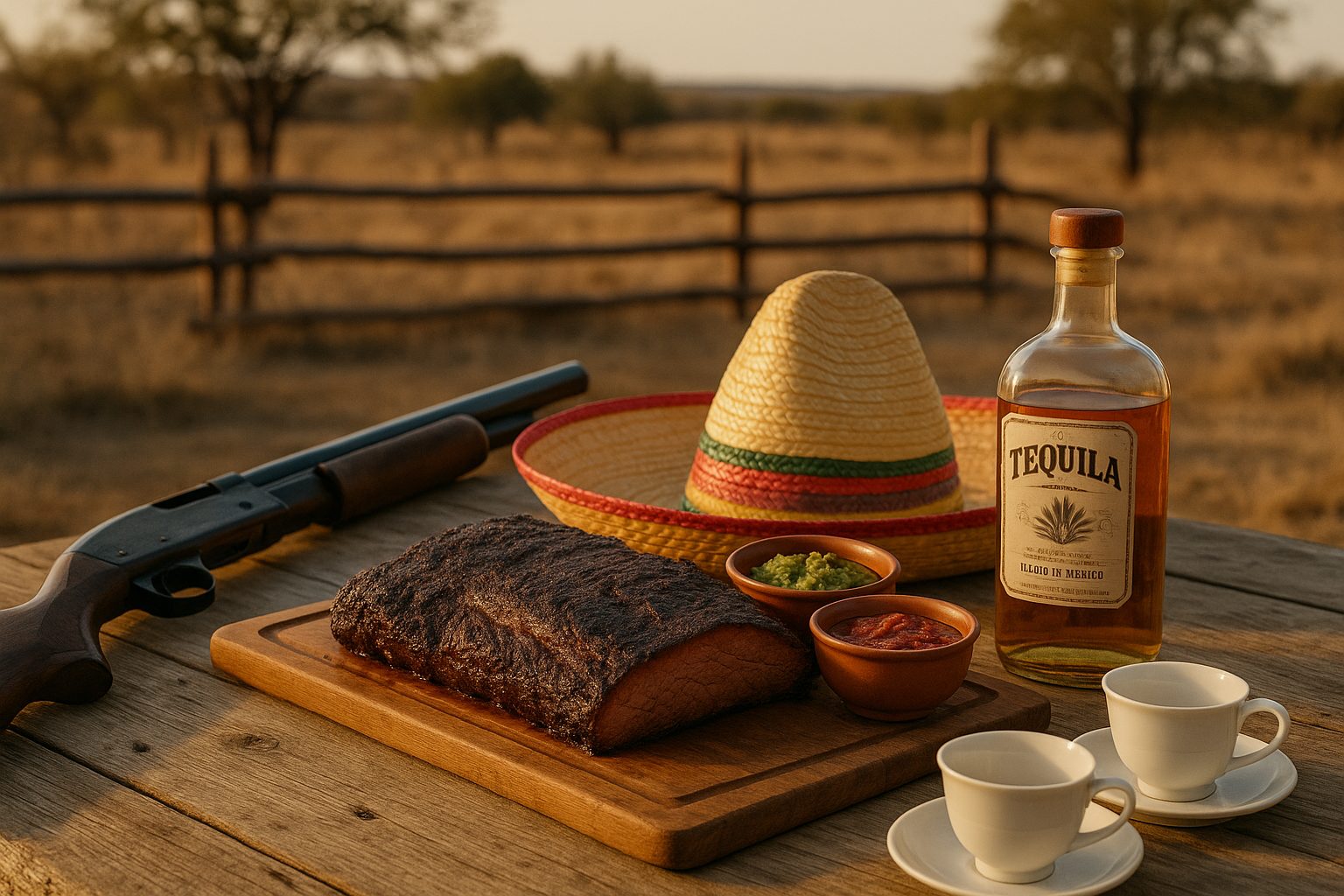
One day—perhaps sooner than expected—the Great State of Texaco will emerge like a phoenix made of denim and hot sauce. I imagine myself standing at its border, wearing a sombrero with a Stetson brim[17], sipping tequila from a porcelain teacup[18], and offering polite nods to my new compatriots as mariachi trumpets blare out an aggressively syncopated rendition of "God Save the King." People around me will speak in a harmonious blend of English, Spanish, and sarcastic British understatement. The air will smell faintly of mesquite smoke and bureaucratic triumph.
And in that moment, as I step across the threshold of the world's most improbable nation, I will reflect upon the strange journey that brought me here: a journey powered by boredom, British pettiness, Russian gullibility, and America's enduring capacity to believe absolutely anything if it circulates widely enough on social media.
I will smile, raise my teacup of tequila to the heavens, and whisper:
"Welcome to Texaco. Population: me."
The author acknowledges that "history" here refers not to rigorous scholarly practice but to a future intern at a digital archaeology lab, sifting through 2016–2025 social media archives while questioning their career choices. ↩︎
The author's laptop was purchased during a Black Friday sale and, while not officially certified for conducting geopolitical mischief, has proven entirely adequate for the task. ↩︎
Dezinformatsiya (дезинформация): A Russian technique of information manipulation distinguished from ordinary lying by its insistence on using at least 12% truth for flavour, much like adding Worcestershire sauce to a stew in which something has gone terribly, terribly wrong. ↩︎
Rule No. 4 of Russian information doctrine: If a narrative sounds implausible, amplify it. If it sounds absurd, weaponise it. If it sounds British, assume it is a trap. ↩︎
For clarity: "annexation" in this context refers to a peaceful cultural merger, not the historical British approach to annexation, which traditionally involved flags, ships, and an unfortunate disregard for existing ownership. ↩︎
BBC News Theme (minor key remix): An arrangement popular in online satire circles, and increasingly used to accompany TikTok footage of unlikely geopolitical developments. ↩︎
No British person has ever successfully explained barbecue to a Texan without being politely corrected, forcefully corrected, or forcibly fed smoked meat until dissent ceased. ↩︎
A 2014 CIA report noted that Americans exhibit "high susceptibility to political provocation, particularly when memes involve firearms, flags, or references to freedom as a consumable product." The report was never published publicly for fear Americans might agree with it. ↩︎
At time of writing, no empirical poll has ever offered Texans "free brisket for life" as part of a referendum question. This is considered by many scholars a tragic missed opportunity for bipartisan unity. ↩︎
The neuroscience study referenced—"Cortical Cowboy Density and Federal Regulatory Aversion"—does not exist, but given modern academia's funding model, it easily could. ↩︎
Infographic produced using Microsoft Paint and an unearned sense of authority. Data visualisation scholars may criticise this method, but disinformation analysts routinely describe it as "authentic" and "on-brand." ↩︎
"Cowboy density" is not, strictly speaking, a recognised demographic metric. That said, the U.S. Census Bureau has made greater category errors. ↩︎
Yevgeny is used here as a composite archetype of the average Russian troll-farm employee, though real Yevgenys undoubtedly exist and deserve hazard pay. ↩︎
It remains unclear how many Congressional staffers genuinely believed Texas might secede, versus how many simply wished to avoid being seen as unpatriotic during a news cycle. American political scientists refer to this behaviour as "performative constitutionalism." ↩︎ ↩︎
The Kremlin's belief that Texan independence represented a strategic opportunity illustrates the enduring geopolitical principle that when one stares too long into the abyss of American discourse, one begins to see patterns that do not exist. ↩︎
The author accepts responsibility for the consequences of this operation but refuses to accept responsibility for American cable news, which is a tragedy of independent origin. ↩︎
The sombrero–Stetson hybrid, while not currently recognised as official headwear, is predicted by cultural anthropologists to emerge naturally within the first five years of Texaco's nationhood. ↩︎
The teacup of tequila symbolises the symbolic merger of British restraint and Mexican exuberance. Studies indicate that consuming tequila from porcelain results in a 17% increase in perceived dignity. ↩︎